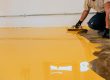

You invested in a new floor. The promise was simple: a showroom-quality finish that would last for years. Now, you are staring at bubbling, patches of peeling, or cracks spider-webbing across your garage floor.
It is incredibly frustrating. You are not alone in this experience. But here is a reality that most contractors avoid: epoxy is a sophisticated chemical system, not magic paint. When that system fails, it is rarely due to bad luck. It is a failure of science, preparation, or chemistry.
If you are currently dealing with a failed floor or planning a new installation, this analysis will explain exactly why these failures occur and why professional epoxy floor refinishing is the only reliable way to fix a botched project.
The “Outgassing” Phenomenon: Why Floors Bubble
Many people ask us about the bubbles that plague their floors. We call this “gassing.” It is essential to remember that concrete is porous. It breathes. Air and moisture vapor are in a constant state of movement through the slab.
When an installer applies a high-solids coating without accounting for that porosity, the trapped air has nowhere to go. It forces its way through the curing epoxy. This creates the crater-like bubbles you see on the surface.
This is a specific failure of environmental control. If the ambient temperature sits too close to the dew point during installation, you are essentially trapping moisture underneath the coating. According to industry standards like those maintained by ASTM International, moisture vapor emission rates must be measured before any work begins. If your installer didn’t perform these tests, they didn’t just rush the job. They guaranteed its failure.
The Preparation Gap: Why “Cleaning” Isn’t Enough
We receive many calls for epoxy floor resurfacing from homeowners who either tried a DIY kit or hired a contractor who treated the floor like it just needed a good scrub.
Standard cleaning, acid etching, or basic pressure washing simply does not suffice for a high-performance floor. For an epoxy floor coating to bond, it needs more than a clean surface. It needs a mechanical profile.
We use professional-grade diamond grinding. This opens the concrete’s pores. If you skip this, you are just applying a sticker to a dusty, greasy slab. It might hold for a month. But as the concrete shifts with humidity or temperature, the adhesion will fail.
Adhesion is measured in PSI. A high-quality epoxy system should bond at 800 PSI or higher. A poorly prepped floor might struggle to reach 200 PSI. That gap is the difference between a floor that lasts twenty years and one that peels off on your tires in twenty weeks.
Spotting the Signs of a Substandard Installation
If you see these warning signs, your floor was likely installed with significant shortcuts. It is better to recognize these early than to keep trying to patch them.
- Fisheyes: These look like small, circular indentations. They happen when surface contaminants like oil or silicone are not properly removed before the base coat goes down.
- Delamination: This is the most severe failure. If the coating is peeling off in large sheets, the bond to the concrete was never established. This is almost exclusively a preparation failure.
- Ambering: If your floor is turning yellow, inferior, non-UV-stable resins were likely used in an area exposed to sunlight.
If you are dealing with these, stop trying to patch the problem. Patching a failed epoxy job is a temporary measure that won’t solve the underlying issue. You need a professional assessment to determine if a full strip-and-redo is necessary. You can learn more about the technical side of this in our guide: Transform Your Home with Residential Epoxy Floor Coating.
Epoxy vs. Polyaspartic: Understanding Chemistry
A common reason for premature failure is selecting the wrong chemistry for the environment.
Epoxy is excellent. It is a high-build, durable primer and base coat. It handles chemical resistance and levels out imperfections beautifully. However, it is not a cure-all. In high-traffic areas or spaces exposed to extreme sunlight and temperature fluctuations, pure epoxy can become brittle or susceptible to plasticizer migration. This is what causes those permanent, yellow tire marks.
This is why we often pair our systems with Polyaspartic topcoats. Polyaspartic coatings provide the flexibility and UV stability that epoxy lacks. They also cure significantly faster. If your previous installer didn’t discuss the difference between a decorative base layer and a protective top layer, they didn’t provide you with a floor. They provided decorations.
The Innovative Custom Coatings Standard
You should not have to worry about your floor every time you park your car. Whether you require a complete epoxy floor resurfacing to fix a previous disaster, or you want an epoxy floor coating installed correctly the first time, the process requires transparency and rigor.
Our approach is built on four pillars:
- Testing: We verify moisture levels. We do not guess.
- Profiling: We use industrial-grade mechanical grinding to ensure the concrete is ready to hold a bond.
- Systemizing: We utilize 100% solids epoxies designed for industrial abuse, not just residential aesthetics.
- Protecting: We apply the correct topcoat, whether Polyaspartic or Urethane, based on your specific traffic requirements.
Avoid the “fast and cheap” trap. When you hire us for epoxy floor refinishing, you aren’t paying for a finish. You are paying for a chemical bond engineered to outlast the concrete it sits on.
Final Thoughts: Invest in Peace of Mind
A floor failure is more than an eyesore. It is a liability. It might be a commercial warehouse where forklifts are tearing up the substrate, or a residential garage where you are tired of scrubbing oil stains. In either case, the quality of your floor matters.
If you are ready to stop dealing with peeling, bubbling, and chipping, it is time to work with a team that treats your concrete like the foundation of your property. Because that is exactly what it is. Are you ready to get it done right? Contact Innovative Custom Coatings today for a free consultation. Let’s evaluate your current floor and design a solution that actually lasts.